
How Ortho-k Works?
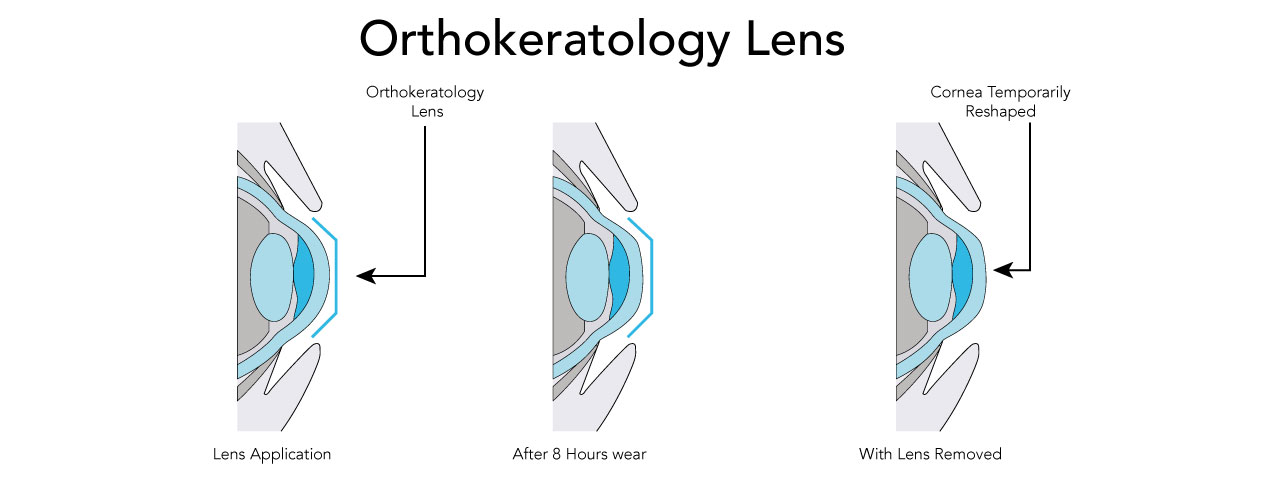
Orthokeratology (ortho-k) is the temporary reshaping of the cornea. Custom-made lenses are worn overnight to provide clear vision throughout the day.
Ortho-k is used to correct and slow down myopia (nearsightedness) in children, and to correct vision in adults.
The Mechanics of Ortho-K
This might remind you of biology class back in high school, but we’ve laid out the basic science behind Ortho-K below. Most people believe that ortho-k lenses function as a mold to press the cornea into a new shape.
Actually, the lens doesn’t even touch the cornea; it floats on a very thin tear film, utilizing gentle hydraulic forces to reshape the cornea.
Regular contact lenses have a perfectly round dome shape. An ortho-k lens uses a reverse geometrical design in which the central area of the lens is flattened. The hydraulic forces applied to the tear film induce pressure to the center of the top tissue layer of the cornea, called the epithelium.
Because the epithelium’s cells are interconnected, the fluid they are filled with can move around between cells. When pressure is applied to the central cells, the fluid moves to the peripheral cells. As a result, the center part of the epithelium becomes thinner, and the periphery thickens.
It is important to remember that cells in the epithelium are not squished, altered, or damaged. The central cells simply undergo dehydration. After the ortho-k lens is removed, the cells gradually return to their original shape as they become hydrated again.
By flattening the cornea in this way, any nearsightedness will be corrected, resulting in perfect daytime vision. Plus, we preserve the natural state of the cornea to slow the progression of myopia.
How is Ortho-K Different from Regular Contact Lenses?
- Ortho-k lenses are therapeutic lenses, not merely a means to correct vision. By reshaping the cornea, they improve eye function. In contrast, most traditional contact lenses merely correct vision but don’t improve it.
- After removing the orthokeratology lenses from your eyes, you will enjoy improved vision for 24 to 72 hours. Many patients can skip a day, for example, and enjoy clear vision, yet some patients need to wear their lenses each night to ensure their vision remains stable. Regular contact lenses correct vision only as long as they are in your eyes.
- With orthokeratology, the patient enjoys the luxury of moving around without having to wear any visual aids such as glasses or contact lenses during the day. This is especially convenient for people who like to play sports and are physically active, and for anyone living in particularly dry, hot, or cold weather conditions.
- Each ortho-k lens is custom-made to the individual patient. In an eye exam, the optometrist uses a corneal topographer—a digital device to measure and map the cornea’s surface—to measure the person’s exact corneal shape.
The Advantages of Ortho-K Over LASIK
- LASIK surgery is not recommended for people under the age of 21. The procedure can only be performed in adults after the eyeball stops growing. By this time, myopia may have reached high levels and is more difficult to treat. In addition, high levels of myopia include a higher risk of severe eye diseases such as glaucoma, retinal detachment, or cataracts later in life.
- Orthokeratology is reversible. A patient can stop the treatment at any time, and the cornea will return to its original shape. LASIK surgery is still an option after a patient has undergone ortho-k treatment.
- Like any other surgical procedure, LASIK involves a certain risk of causing damage to the eye. Ortho-k is non-invasive and does not induce any permanent change to the eye.
- Following LASIK surgery, patients still may need contacts or glasses. The procedure may correct vision only partially. In some cases, patients will require more than one surgical procedure.
- Some patients develop severe dry eye after LASIK surgery.
At River Oaks Family Optometry, we will evaluate if ortho-k is a suitable treatment option to manage your child’s myopia. Schedule an appointment with Dr. Elaine Chung, O.D., for an eye exam today.
Our practice serves patients from North San Jose, Milpitas, Santa Clara, and Sunnyvale, California and surrounding communities.